The First 100 days of Trump & the effect on immigration
The first 100 days of Donald Trump’s presidency have been marred by turmoil, with rippling effects felt both inside and outside the US. In this article, we take an in-depth look at Trump’s first 100 days in office and realise the true impact of his policies and decisions, particularly pertaining to immigration and international relations. We forecast future immigration numbers based on ongoing policies as we examine the beginning and future of Trump’s presidency.
For help and expert advice on your international immigration, US exit strategy or for clarity on your situation, contact us on +1 844 312 4979 or reach out to us online today.
Read our 1983 reviews
We have helped over 25,000 people get their visas approved the first time
Complete the form below to request a call back

Trump’s first 100 days: overview
The first 100 days of Donald Trump’s presidency have been marred by turmoil, with rippling effects felt both inside and outside the US.
A disastrous rollout of international tariffs has sparked vicious trade wars and engendered fears of economic recession. Significant numbers of Americans are considering leaving the US in the midst of ever-increasingly hectic and oppressive immigration policies.
Firings and reorganizations within government agencies have cast aspersions on the integrity of the country’s national security. Climate change initiatives, education funds, and diversity and inclusion programs have been steadily dismantled as part of a larger war against “wokeness”.
Underpinning all of these is Trump’s unprecedented 141 executive orders signed this year so far – significantly more than any previous president in the first 100 days of office. Many of these target perceived enemies of the president and have limited or stripped away powers from people and institutions who Trump considers to oppose the ideals of his new presidency.
In this article, we take an in-depth look at Trump’s first 100 days in office and realise the true impact of his policies and decisions, particularly pertaining to immigration and international relations.
How does Trump fare in the approval ratings?
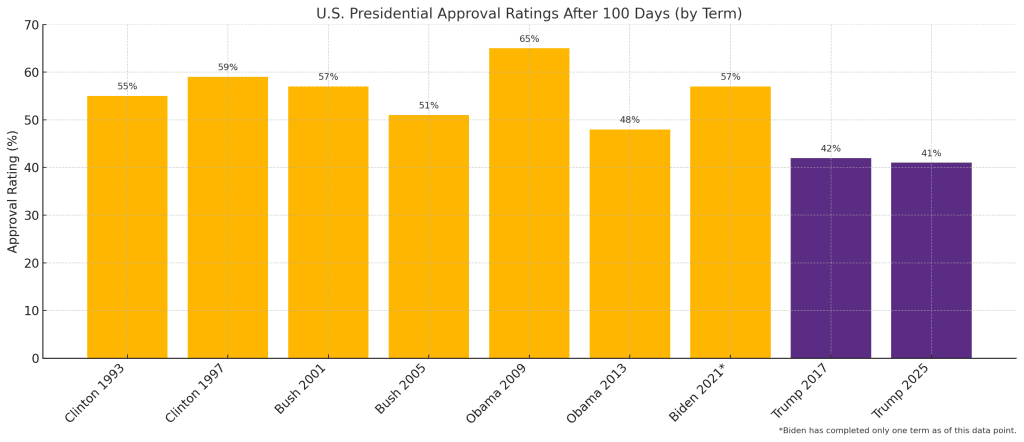
Trump’s actions have not been well-received among Americans. According to an Economist/YouGov survey, the president’s approval rating among the American public is only 41%, down from around 49% in January.
According to Gallup, his average initial term approval rating is now lower than that of every other US president since World War II.
Meanwhile, a poll from the Associated Press-Norc Center for Public Affairs Research shows that only a slim majority of Republicans (54%) say that Trump is focused on the “right priorities” as president, while the normally pro-Trump Fox News found that only 38% of Americans approve of Trump’s approach to the economy, with 56% disapproving.
It’s no surprise, then, that both American citizens and foreign nationals are leaving the US in droves, especially amid increasingly hostile and exclusionary immigration policies being put into place within the US.
Data shows “Donald Dash” could turn into a larger exodus
In the periods immediately after Trump was elected and inaugurated within the previous year, there has been a significant increase in Americans looking for methods to leave the US.
According to IAS data, online traffic to Ireland citizenship pages rose by 800% after Trump’s inauguration. Similar spikes were seen on citizenship pages for Canada, UK and Spain, with a 600% increase seen in UK citizenship pages after Trump’s inauguration.
Similarly, Google Trends shows a significant spike in Americans searching for immigration to Portugal, Costa Rica, and Ireland. Searches also rose for queries such as Canadian jobs for Americans and advice on which countries in the world are easiest to immigrate to.
According to visaguide.world, the overall volume of searches about relocating abroad rose a staggering 1514% in the wake of Trump’s inauguration.
Although similar trends were seen during the start of Trump’s first presidency in late 2016/early 2017, these did not necessarily translate into significant increases in actual migration numbers.
However, international data may suggest a different story this time around.
For instance, it has transpired that over 6,100 Americans applied for UK passports in 2024 alone, with the largest numbers of applications being lodged in the last part of the year after Trump’s re-election. These numbers are the highest seen since records began in 2004, strongly indicating an increased sense of purpose among the American population to leave the country in response to a second Trump presidency.
Additionally, Ireland has seen a 50% rise in foreign birth registrations in the US, with a 10% rise in Irish passport applications from the US in 2024, also representing notable upticks from previous years.
We will have to wait a little longer to see if these figures will result in significant increases in emigration from the US. However, there is little doubt that Trump’s presidency is at least having a serious effect on many people’s desire to stay in the US, given the tumultuous and worrying effects of many of his new policies.
Americans planning dual citizenship
Mexican consulates in Dallas, Phoenix, and Atlanta report a 44% jump in dual‑citizenship requests – a hedge against removal, while at IAS we have seen huge spikes in interest for British, Irish, Spanish, Italian, and Canadian citizenship, among others. IAS immigration lawyer Dina Modi said:
“Many clients are looking at options as a precautionary measure. However, we are also seeing more of those translate into citizenship applications, often for dual citizenship.”
“Most enquiries express the same concerns. That is uncertainty over the political changes in the US and the Trump administration. Many clients have expressed that their views do not align with the current government and are anxious about what the future holds for them and the welfare and their families.”
“Another recurring concern is fear. Particularly from same-sex couples, and the increasing pressure from various states to ban such marriages. Ultimately, we’ve found that American clients are willing to consider all temporary and settlement options primarily resulting from fear and uncertainty.”
Where are Americans going?
Americans looking to move from the US, citing fears and uncertainty, are eyeing options across North America, Europe, and as far as Oceania.
- Individuals and families are exploring familial connections to places like the UK, Ireland, Italy, and Spain, which are among the best countries for Americans to move to, as well as Canada and Mexico.
- Business people and venture capitalists are turning to more certain economic climates like Canada, Ireland, and Germany.
- Those with Temporary Protected Status (TPS), largely from Latin America, are looking at dual citizenship in Mexico and places with Latin connections like Portugal and Spain.
- Larger businesses are moving manufacturing abroad following the impact of Trump’s tariffs
- Clients from marginalized communities making enquiries based on fear and uncertainty are willing to consider relocation anywhere overseas

Why are Americans leaving and changing travel plans to avoid the US?
Americans are citing a swathe of reasons for leaving the US for other countries.
Among these is an increasingly hostile and volatile landscape for foreign nationals and US residents, as well as fear and anxieties among marginalized groups regarding the current administration’s policies. Overseas workers, students, families, and businesses have all been affected.
51% of Gen Z say the “new American Dream” is leaving America
Younger Americans increasingly view mobility, not permanent settlement, as the hallmark of success – a seismic shift in the traditional American Dream.
We are witnessing a disproportionate number of Gen Z and Millennial Americans leaving or exploring their options for leaving the US. IAS data covering the Donald Dash concluded that Gen Z is 3× more likely than Americans 55+ (13.8 %) to contemplate leaving, signaling a potential future brain drain. Overall, our data showed 1 in 4 Americans are weighing emigration.
Additionally, Howdy.com reports that 76% of the Gen Z and Millennial demographic see living and working “anywhere they want” as the new American dream. 43% of young Americans surveyed plan on becoming digital nomads due to the results of the American elections. Similarly, 43% reported feeling trapped in the US, and 51% said that being able to leave America is the new American dream.
Threats of mass deportation weigh heavily on immigrant families
Trump’s enforcement plans tell an ever more sinister story. According to ICE statistics, the number of individuals without criminal records arrested and detained rose by 500% from January to March of this year, with new facilities and detention centers currently being established to accommodate these numbers.
Trump has advocated for unprecedented levels of mass deportations, detentions, and confinements. His prime target has been illegal immigrants, but even those with legitimate legal status in the US have been targeted, allegedly in some cases because they have criticized Trump’s policies or spoken out in support of Palestine. One of the major effects is on those with Temporary Protected Status (TPS).
Immigrants with temporary permits lose deportation protections
A key move from Trump’s administration was to remove temporary deportation protections (TPS) for many non-US citizens.
TPS is an immigration status given to those who may face unsafe conditions if they have to return to their home country. The status is usually initially granted for 18 months and protects holders from a variety of situations, including war and natural disasters. It also allows them to find temporary work while in the US. It is reported that there are over 570,000 people actively working in the US under temporary protected status.
The Secretary of Homeland Security makes the decision to award TPS to citizens of certain countries. Since the start of Trump’s presidency, TPS has been removed for citizens from Afghanistan and Cameroon. It is expected that the removal of TPS could impact more than 14,000 Afghans and around 8,000 Cameroonians, who will have little choice but to return home or be deported.
Plans to remove the status for those from Haiti, Cuba, and Venezuela are also in place, but the White House is facing ongoing legal challenges to that decision. Temporary Protected Status holders from Haiti and Sudan face six‑month “rolling reviews” that keep them in perpetual limbo.
There is also ongoing uncertainty for Ukrainians who fled to the US following the conflict with Russia. For those already granted TPS status, it has been extended to October 2026. However, those currently in the process of applying are still waiting for confirmation on their right to stay following Trump’s suspension of the Uniting for Ukraine pathway.
Trump cuts asylum routes from Mexico
On taking office, Trump introduced a shakeup at the US Immigration and Customs Enforcement (ICE) with an overhaul of personnel and a focus on increasing the number of people being deported, especially those attempting to cross the border from Mexico. A key change was to tighten the seeking of asylum for those fleeing persecution.
Within days, Trump shut down the CBP One app that had been launched by President Biden to enable those seeking asylum to schedule appointments with immigration officials. With the app no longer available, around 30,000 appointments were cancelled, and CBS estimates a further 270,000 migrants were left unable to proceed as there was no longer a legal route for them to come to the US.
In a further move to reduce migrant travel between the US and Mexico, the high-profile Trump wall construction is also set to resume after being halted under Biden. A new Homeland Security $70 million contract has now been negotiated to complete an additional seven-mile section in the Rio Grande Valley. Much larger future contracts are also pending Congressional approval.
With increased powers and officer numbers, ICE arrested more than 32,000 people in the first 50 days of Trump’s presidency. However, this was below Trump’s goal of 1,200 to 1,500 per day, and by February, it was estimated that arrests were less than 600 per day. After this, ICE stopped publishing daily numbers, so it is not clear what the current level is.
The re-enaction and expansion of Trump’s travel ban
Trump’s revived travel ban now covers additional countries, including Sudan and Nigeria. Alongside the new restrictions, tighter security screenings at major airports have sharply increased visa denials, with African business travelers facing a 22% rise in rejections over the past year.
New measures like mandatory polygraphs and strict export-control checks have also taken a toll. One in three offers made to Chinese and Iranian STEM scholars has been withdrawn, sparking fears that US research and innovation could suffer long-term setbacks.
Visitors are turning away before being turned away from the USA
Tourists and temporary visitors have also been detained by border officials, even when attempting to leave the US and return to their home countries, indicating a level of hostility and scrutiny that has deterred both current US residents and overseas tourists from spending time in the US in the future.
A Guardian analysis cited U.S. Travel Association economists who link a 4% year‑on‑year drop in forward bookings to “a string of arrests and detentions of travelers,” including several stopped while trying to leave the country.
Middle Eastern travelers, in particular, report heightened questioning and delays, feeding a broader sense that America is becoming increasingly unwelcoming to outsiders, even those simply passing through
Canadian government warns residents of delays & scrutiny when visiting the US

Ongoing tensions between the US and Canada since the start of the year have caused an increase in potential security issues at the border.
An official statement from the Canadian government has warned its residents that they should be prepared for more scrutiny if traveling to the US. In some cases, they should be ready to have their electronic devices examined. Any refusal could see them prevented from entering the US.
In particular, those who have Canadian citizenship but may have been born in the Middle East are advised to consider whether their journey is necessary following a number of incidents in which people were detained by the US Border Control.
It is also expected that the additional checks at the border could continue to contribute to a decline in Canadians entering the US. According to the latest US Customs and Border Protection figures, the US state of Michigan has seen an 11% fall in travelers from Canada compared to the same point in 2024. Locals have already raised concerns that the drop in traffic could impact tourism significantly.
With Mark Carney’s Liberal Party winning the Canadian election, Trump’s approach to border control is likely to face ongoing opposition.
Legal immigration crackdown
Family Green Card processing is slowing
There have also been reports of extended delays for family immigration routes and Green Cards, with processing times stretching out as long as two to three years. Commentators have cited harsher processing guidelines and understaffing issues at USCIS as potential reasons for the delays.
Family reunification is slowing to a crawl. Staffing shortages and stricter vetting have pushed spousal green‑card processing to thirty months and more, while fiancé‑visa interviews are booking a full year out.
Fewer H1-B visa slots cause businesses to relocate to Canada & Mexico
The H-1B visa has received significant press coverage for alleged abuses within the visa system and arguments that American citizens are being excluded from certain job opportunities.
Trump has voiced his support for the H-1B visa system, though there have been recent reports that H-1B visa holders and applicants are being subject to increased scrutiny at the hands of USCIS, in addition to newly announced changes to reduce yearly caps and make it more difficult for employers to petition for prospective applicants.
A 40% reduction in H‑1B visa slots has already left 19,000 technology openings unfilled. Several firms are relocating R&D projects to Canada or Mexico, where work permits remain predictable.
Graduate route changes likely to see lower international student enrollments
One focus of the new Trump regime has been to crack down on legal immigration routes and the number of individuals who can use them.
International graduates are squeezed. The STEM‑OPT work‑extension window is down from three years to twelve months for many STEM graduates, prompting US universities to forecast a 17% drop in new international enrollments for fall 2025.
Trump’s plans to shake up Birthright Citizenship faces a challenge
Trump has signed off on an executive order to permanently remove birthright citizenship in the US, stating last year that the practice is “ridiculous,” and that “we have to end it.”
Although this order is currently facing significant legal challenges, not in the least because it would require a significant constitutional amendment, it is another example of Trump’s governance imposing further difficulties on the ability of migrants and non-Americans to establish a life in the US.
LGBTQ+ community feels “exiled”

In a highly-publicized move criticized by activists, human rights organizations, and members of the LGBTQ+ community, Trump has also signed an executive order to rescind “all radical gender ideology guidance, communication, policies, and forms”, which aims to significantly limit the rights and freedoms of trans individuals in the US.
Online searches for transgender asylum in the UK increased by 600% directly after Trump was re-elected last year, further underlining desires for trans individuals and their families to escape increasingly harmful and hateful rhetoric surrounding gender reforms in the US.
Sexual orientation and gender identity asylum claims were removed from the fast‑track docket. Detention for LGBTQ+ applicants now averages 112 days, and trans women from Latin America are housed in mixed‑gender facilities, prompting a lawsuit citing Eighth‑Amendment violations.
Dina Modi, Advice Team Leader for IAS, confirms that Americans are looking to leave the US due to anxieties about “what the future holds for them and the welfare and their families”, particularly in reference to same-sex couples and “increasing pressure” from several states to ban same-sex marriages.
International tariffs prompt global fallout, with businesses moving manufacturing from the US

The Trump administration’s new 15 % blanket tariff landed like a lead balloon. US partners woke up to price hikes on 7,900 product lines—everything from microchips to mozzarella—and global markets recoiled.
Within 48 hours, the S&P 500 slipped ‑4.3 %, wiping roughly $1.6 trillion from U.S. equity value, while the Dow sold off 1,200 points. Analysts compared the mood to the first days of the 2018 tariff cycle, only broader and faster. Others compared the sell-off with the 2009 market crash. Soon, the retaliations began with something of a trade-tussle threatening a larger trade war.
China responded with sweeping counter-tariffs, targeting high-profile farm goods to hit swing-state producers. They hinted at curbs on civilian jet orders to pressure a marquee manufacturer, and used customs friction to squeeze US exporters without formally banning goods.
The EU re‑imposed 25 % duties on American soybeans and corn. India assigned higher tariffs on almonds and apples, two crops worth $3.1 billion to U.S. growers. Brazil shelved a pending $2 billion aviation‑parts deal. Semiconductor foundries in Taiwan began factoring compliance fees into their costs, triggering higher server prices.
Many American businesses have reacted by moving manufacturing from the US to Vietnam, Mexico, Canada, and beyond.
Are Trump’s tariffs an invitation to negotiate or the beginning of a trade war?
Despite Trump sticking by his guns, urging Americans that “I know what the hell I’m doing”, the White House quickly backtracked on smartphone tariffs. It was an early sign that some levies may prove temporary, and that Trump was willing to negotiate favourable deals.
Trump’s meeting with Italy’s Georgia Meloni served up the base for a new trade deal with the EU. “There will be a trade deal, 100%,” Trump said, “but it will be a fair deal”. It remains to be seen if the tariffs are a dramatic bargaining chip or a serious long-term policy, but it has served as a tacit admission that universal tariffs carry domestic political risk.
Increased deportations after Trump invoked the Alien Enemies Act

Trump has also increased deportations by invoking the Alien Enemies Act of 1798. Usually reserved for wartime, the law allows the president to detain citizens of an ‘enemy’ nation without a need for a hearing.
It has been a major driver for deporting alleged members of the Venezuelan Tren de Aragua gang, which has been classed as a terrorist organization. However, human rights groups are now questioning whether the law has been implemented correctly, given media coverage of possible administrative errors and people being wrongly being deported.
According to the New York Times, there have been around 250 deportation flights since the start of Trump’s presidency, which is similar to the level seen in the final months of Biden’s term.
Initially, the flights were made using military aircraft, but this has now stopped due to escalating costs. Of course, flights are not the only sign of deportation, with many deported by land, especially to Mexico. However, without official figures, it is difficult to estimate the impact of Trump’s approach.
Many deportees are not being returned to their home country, and Trump has negotiated with many Latin American countries to accept deportation flights. Receiving countries include:
- Brazil
- China
- Colombia
- Costa Rica
- Guatemala
- Honduras
- India
- Mexico
- Panama
In addition, small numbers of migrants have been sent to the infamous Guantanamo Bay in Cuba while awaiting deportation to another location.
As part of the deportation plans, Trump has also confirmed the reopening of several detention centres across the US. Facilities in New Jersey, Ohio, Nevada, Oklahoma, Texas and Mississippi have all been given new contracts to work with ICE to create additional capacity ahead of further policy changes.
It is estimated that expanding detention provision could cost around $45 billion in the long term, with many private prison companies already bidding for tenders.
The US is accused of a “retreat from humanitarian leadership”
International media frame the mix of tariffs and deportations as a “double wall”: one around goods, one around people. Trump’s “America first” ideology threatens isolationism.
Polish and German officials called it “a retreat from US humanitarian leadership” when another of Trump’s policies saw a freeze on the Unite for Ukraine policy, in a move affecting 180,000 Ukrainians.
Trump’s policies on mass deportations have led to diplomatic pushback that fell on deaf ears. Colombia was somewhat forced into a “last‑resort” pact, signing a modest returns agreement only after Washington threatened beef and coffee sanctions worth $1.8 billion per year. India, Guatemala, and Honduras also refused higher deportation quotas, describing “destabilizing brain drain.” US diplomats in New Delhi privately concede visa services slowdowns may follow.
Trump’s future plans for deportation and border control
So, what does the next 100 days mean for mass deportations and increased border control? While Trump’s approach has drawn support from parts of the electorate, there are some growing concerns that he may have “gone too far”, especially when targeting some immigrants.
A recent survey conducted by the Associated Press-NORC Center for Public Affairs Research found that 46% of Americans approve of Trump’s stance on immigration.
However, there was less support for large-scale deportations, especially following media coverage of some people being wrongly deported to El Salvador. Respondents also raised concerns about revoking student visas for those involved in pro-Palestinian activism, with close to 50% not in favor.
Foreign aid cuts devastate NGOs
A $1.2 billion USAID freeze covering Central America, the West Bank, and East Africa has forced fourteen NGO field offices to close or shift to European funding. Oxfam, Mercy Corps, and Save the Children have shed six hundred US jobs, with wider effects being realised in Europe.
Separately, a White House blueprint to “privatize” Gaza’s reconstruction drew unanimous condemnation at the UN Security Council, with NATO allies warning of long‑term blowback. Favorability polls in Kenya and Jordan show the steepest drop in US approval, which has shifted by up to fourteen points since 2003.
The economic fallout of Trump’s unpredictability
The combined effect of tightened visa regulations and broader tariffs is pinching supply and demand. Consumer prices tell the other half of the story. Appliances and apparel cost 7% more than a year ago, while fresh produce is up 5%, the result of both import duties and farm‑labor gaps.
Economists warn that if current policies hold through 2025, GDP growth could slip below 1% while inflation remains above 4%. This is a textbook stagflation scenario. Venture capitalists are voting with their feet as seed funding $4.5 billion shifted, flowing from New York to Toronto and Berlin as founders cited “regulatory unpredictability.”
How is Trump’s isolationist America viewed in the US and internationally?
Politically, the nation is diverging. Approval in deep‑red states is up seven points, fueled by praise from evangelical leaders who view tariffs as moral self‑defense.
Blue states are racing the other way. California has unveiled a state‑sponsored “Golden Visa Lite,” while Illinois has expanded sanctuary‑city funding. Five federal injunctions have already delayed key rollouts, and the Supreme Court will fast-track a dispute over deportation quotas this autumn, potentially defining executive removal power for a decade.
Control of the Senate, now 52‑48 Republican, could pivot in the 2026 midterms on races in Arizona, Nevada, and Pennsylvania states, uniquely exposed to both immigrant labor shocks and tariff pain.
Some stances, such as Trump’s insistence on NATO members doing more and paying more, were met with approval from the deep red states, and so far, Europe has responded fairly apologetically to that message, promising to accommodate a stronger defence budget with elevated NATO payments. Other policies have seen political leaders take turns to sway Trump on various issues, from the Russia-Ukraine conflict to trade agreements.
Summary of Trump’s first 100 days in office
One of the defining elements of Trump’s first 100 days has been the impact on immigrants already living in the US.
From his first day in office, there has been a focus on the deportation of non-US citizens, with many of his supporters believing a tough stance on the issue will help to boost the country’s economy and open up jobs for Americans.
Throughout his presidential campaign, Trump pledged to increase border enforcement and implement mass deportations, so it was no surprise that within days of entering the White House, he had issued a number of executive orders aimed at achieving those goals.
Following several changes to immigration policy and an unprecedented number of executive orders, there appears to be a real threat to the continuity of life for many Americans, not only those who have arrived in the US under protected status. Student and tourist routes to the US are under the microscope, together with routes for skilled workers and their families.
International law is preventing some of Trump’s plans, but with the ‘red wall’ still engaged, Trump remains buoyed. His presidency has disrupted international relations from Ukraine and Russia to China. Trade wars continue to affect politics across the Atlantic, and the spread of policies has prompted nations to tread lightly against the ‘hard line’ that Trump has put down.
The mid-terms will represent another chance to reflect on Trump’s presidency thus far, and see if the chaos and unpredictability that seem to have been a hallmark in Trump’s first 100 days dies down.
Forecasting the future of US Net Immigration if policies persist
Forecasting the future net migration statistics for the US is difficult, however, we know that if the current policies persist, net migration is expected to reduce by between 60% – 120%.
This depends on a lot of variables, and expert consensus among most demographers (Cato, Migration Policy Institute, U.S. Census) project a slim +150 k– +250 k net migration for 2025, even under aggressive deportation scenarios.
| Action | 2023 (baseline) | 2025 projection if current policies persist | Key driver/assumption |
| New green‑card approvals | 1.05 million | 800 k – 840 k (▼ 20 %–24 %) | Family‑visa backlog + 40 % cut in employment‑based quota |
| Employment‑visa approvals (H, L, O) | 410 k | 270 k – 300 k (▼ 27 %–34 %) | Cap cuts, higher denial rates, extended security screening |
| Refugee & humanitarian admissions | 45 k | 18 k – 22 k (▼ 50 %–60 %) | Annual ceiling reset to 18 k; parole pathways frozen |
| Estimated U.S.‑citizen emigration | 295 k | 360 k – 400 k (▲ 22 %–36 %) | 25 % “exit intent” converts at ≈ 1 in 10; Gen Z leads outflow |
| Forced removals (ICE deportations) | 185 k | 600 k – 750 k (▲ +225 %–300 %) | Administration target of “3 million in four years”; surge courts upheld |
| TPS expirations at risk | N/A | 380 k holders face loss of status by mid‑2025 | Termination of TPS for El Salvador, Honduras, Nicaragua, Haiti expected Q1 2025 |
| Net migration balance | +750 k | +300 k → ‑100 k | Declining inflow + higher removals + higher outflow could tip the US into negative net migration. Forecasts vary. |
How Can IAS Help?
If you are looking to explore your immigration options, IAS offers immediate immigration and relocation assistance. We offer advice, application support and checking services to ensure your smooth immigration.
We are a team of expert and compassionate immigration lawyers who can work with you to explore all of your options to enable you to reunite with your family, move your business overseas, relocate or transfer employees, and much more.
Table of Contents
Table of Contents will appear here.
Legal Disclaimer
The information provided is for general informational purposes only and does not constitute legal advice. While we make every effort to ensure accuracy, the law may change, and the information may not reflect the most current legal developments. No warranty is given regarding the accuracy or completeness of the information, and we do not accept liability in such cases. We recommend consulting with a qualified lawyer at Immigration Advice Service before making any decisions based on the content provided.
Services we Provide




Related Posts

US October 2026 Visa Bulletin: What Nigerian Green Card Applicants Should Know
Last modified on October 14, 2026 at 5:06 pm

UK Introduces New Immigration Rules: What Nigerians Need to Know
Last modified on October 14, 2026 at 5:05 pm
How to Avoid PERM Suspension Like Microsoft: HR Compliance Checklist
Last modified on October 13, 2026 at 7:57 am

Your Rights While in UK Immigration Detention
Last modified on October 8, 2026 at 5:25 pm

Temporary Protection Transition Scheme Ireland
Last modified on October 6, 2026 at 2:14 pm

New Passport Rule for UK-Ireland Travel on Ferries
Last modified on October 5, 2026 at 4:22 pm
Belgium: Flanders Introduces €180 Single Permit Fee
Last modified on September 17, 2026 at 3:37 pm
The UK Is Tightening Its Immigration Rules — What Nigerians Need to Know Before 2027
Last modified on September 18, 2026 at 10:29 am

France Tuition Fees 2026–2027: What Non-EU Students Need to Know
Last modified on September 17, 2026 at 3:27 pm