Ireland Immigration: Pathways for Nigerian Citizens
Nigerian citizens can immigrate to Ireland for different purposes including to live, work, or study.
If you need guidance on immigrating to Ireland from Nigeria, IAS can help. For more details on Ireland visa requirements for Nigerian citizens and citizenship pathways, call us at +23413438882 or complete our online enquiry form for immediate assistance.
Read our 1983 reviews
 Last modified on March 11, 2026 at 7:28 pm
Do You Need Help Immigrating to Ireland?
We have successfully assisted many Nigerians in realising their dream of relocating to Ireland. If you need help, we can guide you through the requirements for the immigration pathway that suits you. Let us handle these complex processes on your behalf and ensure your visa application is stress-free.
Overview of Immigration Pathways for Nigerian Citizens to Ireland
Nigerian citizens looking to immigrate to Ireland can do so through several immigration pathways. You must choose the immigration pathway that suits your situation and travel purpose. If you intend to stay in Ireland for less than 90 days, you can apply for a short-stay C visa. Individuals who wish to remain in Ireland beyond 90 days must choose a long-stay D visa.
Nigerian nationals who intend to enter Ireland for work must obtain an Irish work permit and visa to work. Those who wish to study or join their family members must obtain a study and family visa that suits their situations, respectively. If you intend to set up a business in Ireland, you can do so when you fulfil the Business Visa requirements.
If you intend to remain in Ireland long-term and obtain Irish citizenship, you can do so via eligible Irish visas. You may need the guidance of an expert immigration lawyer to immigrate to Ireland from Nigeria error-free. At IAS, our immigration lawyers understand all the requirements you must meet.
We can help you complete the complex processes involved in these immigration options. We can ensure you make a comprehensive application for the immigration option that suits your circumstances while adhering to the Irish immigration rules.
Work Visas and Permits for Nigerian Citizens
An Irish Work Visa is a travel document permitting Nigerian nationals and non-EU/EEA citizens to enter Ireland for employment. Nigerian citizens who intend to work in Ireland must obtain a valid employment permit and apply for a work visa.
The Department of Enterprise, Trade and Employment (DETE) is the Irish authority that issues Employment Permits in Ireland. However, the Irish immigration officers must permit you through Border Control to be allowed to enter the country with an Employment Permit, including:
General Employment Permit
The General Employment Permit is issued to individuals ineligible for Critical Skills Employment. There is no specific list of eligible occupations for the General Employment Permit as almost all types of foreign workers can apply for it, except their profession is in the Ineligible List of Occupations for Employment Permits. You must have secured employment in Ireland before you apply for a General Employment Permit. The General Employment Permit costs €600 or €1,000 for 6 months/less or €1,000 for 6 months to 2 years work duration respectively.
Eligibility Criteria for General Employment Permit
- Your employer must have passed the Labour Markets Needs Test (LMNT) for the General Employment Permit, demonstrating they could not find any Irish, Swiss, EU, or EEA worker to do the job you’ve been offered.
- Your employer must be licensed to operate in Ireland.
- You have a job offer or contract from an Irish employer.
- Your job must not be on the list of ineligible occupations.
- You must qualify and possess the skills required for the job.
- Irish, EU, EEA, or Swiss citizens are 50% of your prospective company’s workers.
- Your salary must be at least €34,000 yearly (estimated to increase to €39,000).
Application Process for General Employment Permit
Nigerian citizens or their Irish employers can apply for a General Employment Permit by completing and submitting an online form. They can do this via the Employment Permits Online System (EPOS). Your application will be placed in the processing queue for review by an immigration officer.
The officer will assess your skills and qualifications to determine if you qualify for the General Employment Permit. After the review, a decision will be made on your application.
If the immigration officer needs more information on your application, you must provide them within 28 days. After an unsuccessful application, you will be given a reason for it and an option to appeal. You must appeal the application refusal decision within 28 days.
Required Documentation for General Employment Permit
- Nigerian passport or other travel documents.
- Details of your work contract.
- The General Employment Permit application form.
- Passport-size photographs that comply with the Irish photo guidelines.
- Birth certificate, Marriage certificate, or divorce certificate (if required).
- A copy of your qualifications.
- Details of your employer.
- Proof your employer passed the Labour Markets Needs Test.
- A copy of your current immigration stamp (for Nigerians already in Ireland when applying).
- Proof of your English proficiency, etc.
Critical Skills Employment Permit
This Employment Permit is issued to non-EU/EEA citizens (including Nigerians) who intend to enter Ireland for jobs listed under the Critical Skilled Occupations List. The Irish government designed this permit to fill skill shortage gaps under high-skilled eligible occupations in the Irish Labour Market.
These occupations include engineering, ICT, architecture, health, medical practitioners, etc. This Employment Permit encourages highly-skilled foreign workers to become permanent residents in Ireland. The Critical Skills Employment Permit costs €1,000. Critical Skills and General Employment Permits have an initial validity of 2 years. When they expire, foreign workers can obtain another permit valid for 3 years, after which they can apply for long-term residency. As of September 2, 2024, applicants are no longer required to stay in their jobs for 12 months or more. They can change employers after 9 months, provided the job is within their occupation.
Criteria for Critical Skills Employment Permit
- Your occupation must be under the Critical Skills Occupation List.
- You’ll earn €38,000 yearly or more (increased to €44,000).
- You must have relevant skills and qualifications for the job
- You’re earning about €64,000 or more in any other occupation not listed under the Ineligible List of Occupations for Employment Permits.
Benefits of Critical Skills Employment Permit
- Employers don’t require the Labour Markets Needs Test.
- International workers can bring their dependents through the family reunification programme.
- Foreign workers can apply for another permit to remain and work in the country when it expires.
Intra-Company Transfer Permit
This Employment Permit is issued to Nigerian citizens who intend to transfer to an Irish branch of their company in Nigeria. The Intra-Company Transfer Permit is issued to key personnel, senior management or trainees of a multinational corporation.
Specific Requirements for Intra-Company Transfer Permit
- Senior Manager earning at least €46,000 yearly.
- Key Personnel earning at least €46,000 yearly.
- Personnel undergoing a training programme and earning at least €34,000 yearly.
At IAS, we can help you obtain an Irish Employment Permit and secure your Work Visa to allow you to work for your employer in Ireland. Our immigration lawyers can help you gather all the required documents for your Employment Permit and Work Visa to make your application stress-free. Call us at +23413438882 or message us online for immediate assistance.
Study Visas for Nigerian Citizens
Ireland Study Visas are issued to Nigerian students who intend to advance their educational careers in Ireland. Nigerian students must be enrolled in a full-time course on the ILEP (Interim List of Eligible Programmes). You can obtain an Ireland C Study Visa for a course that will last within 3 months or a D Study Visa for a course that will last beyond 3 months.
Eligibility Criteria for Ireland Student Visa
- An Irish educational institution has accepted and enrolled you.
- Your course is full-time and is on the ILEP.
- You have paid your tuition fees.
Application Steps for Ireland Student Visa
- Choose your preferred Irish institution.
- Gather all required documents.
- Apply online via the Irish Naturalisation and Immigration Service (INIS) website.
- Pay the Ireland visa fee in Nigeria after completing the form.
- Attend the visa interview.
- Await the visa decision.
- Visa approval.
- Collect your visa.
Required Documents for Ireland Student Visa
- A valid Nigerian passport.
- Two colour passport-size photographs.
- Proof of health insurance.
- Application form.
- Application letter.
- Acceptance letter from the Irish institution.
- Proof of English proficiency.
- Evidence of tuition fee payment to your institution.
- A Police Clearance Certificate (PCC).
- Proof of scholarship or tuition payment.
- Evidence of sufficient funds to cover living expenses.
- Proof of accommodation.
- Statement of purpose.
- Details of previous visas
- Proof of your academic ability to study the course you chose.
- Evidence to explain gaps in your academic history.
Differences Between Short-term and Long-term Study Visas
The short-term and long-term Ireland study visa durations differ. If you intend to study in Ireland for more than 3 months, apply for a D Study Visa. But if you wish to study in Ireland within 3 months, apply for a C Study Visa. Also, short-term and long-term study visas have different Ireland visa online application forms.
Benefits of Ireland Study Visas
Nigerian students can enjoy these benefits of studying in Ireland:
Top-ranked Universities
Ireland has some of the top-ranked universities in the world. Irish universities have gained worldwide recognition for their academic excellence, industry partnerships and research output. Some renowned Irish universities include Dublin City University, University College Dublin, Dublin Business School, etc.
Competitive Costs
Ireland offers competitive educational costs when compared to other English-speaking countries. The affordable living costs and tuition fees make Irish universities sought-after destinations for international students. The average price of tuition fees in Ireland is €10,000 to €35,000.
Job Opportunities
Ireland has a booming economy and partners with multinational industries, providing many job opportunities for graduates. Some of the prominent industries in Ireland include export and trade, pharmaceuticals, technology and software, and financial services.
Our immigration lawyers at IAS can help you complete your application for an Ireland Student Visa. We can help you gather all the required documents and make a comprehensive application. Call us at +23413438882 or message us online for immediate assistance.
Family Reunification – Bringing Family Members to Ireland
Nigerian citizens with permission to remain in Ireland can bring their family members through the Family Reunification Visa. The resident permit or status (refugee status or subsidiary protection) a family member has in Ireland determines whether or not you can join them.
Eligibility Criteria
You must be any of these to join a family member (sponsor) in Ireland:
- Parent.
- Spouse.
- De Facto partner.
- Your dependent child below 18 years or child below 23 years studying full-time.
The family member you’re intending to join in Ireland can be:
- An Irish citizen.
- An EU/EEA/Swiss citizen.
- Another non-EU/EEA citizen.
- A UK national.
- A PhD student in an accredited Irish program.
- A Minister of Religion holding Stamp 3.
- A non-Irish citizen living in Ireland on Stamp 4 or Stamp 5.
- A Researcher under a Hosting Agreement.
Application Process
To apply for a Family visa from Nigeria, your sponsor must deliver a letter to the INIS Family Reunification section. The letter must include their name, personal ID, and address. The letter will also contain your details (such as name, address, date of birth, nationality, and relationship type).
Once the INIS receives the letter, it will send a questionnaire to your sponsor along with a list of documents. Your sponsor must complete the questionnaire and submit it to the INIS along with all the required documents. After the application is approved, you can apply for an Ireland Join Family Visa from Nigeria.
Required Documents
- Two passport-size photographs.
- A valid Nigerian passport.
- Birth, marriage, or adoption certificate (to prove your relationship).
- A completed visa application form.
- Your sponsor’s job application form.
- Your sponsor’s passport prove they are allowed to sponsor you.
- Birth, adoption, or marriage certificates to confirm your relationship.
- A letter explaining the reason for your travel, including your sponsor’s details.
- Copies of your 6 months bank statements and your sponsor’s too.
- Last 3 months’ payslips.
- Medical health insurance of at least €25,000.
- Proof of your sponsor earning at least €30,000 in the past 2 years and €40,000 in the past 3 years if they are an Irish citizen and Employment Permit holder, respectively.
- Proof of relationship history with your sponsor.
- Notice of income assessment (if your family member runs a business), etc.
The documents you’ll provide for a Family Reunification Visa depend on your circumstances. Any document in a foreign language must be translated by a licensed translator and notarised.
Dependent Family Member Visas
If you’re a dependent family member or child of an Irish resident and intend to join them in Ireland, obtain a Dependent Visa.
Eligibility Criteria
- Your sponsor is married to or is an Irish national.
- You’re 16 to 18 years old or studying full-time and under 23.
- You’re over 18 years old but rely on your parent sponsor’s care due to a serious psychological or medical issue, which is difficult to manage in Nigeria.
- You live together with your sponsor as a family member.
- You don’t live alone permanently.
- Your sponsor is an Irish resident holding Stamp 1, Stamp 4 or Stamp 5.
- Your sponsor has fulfilled the minimum stay requirement to permit family reunification.
Challenges in the Family Reunification Process
You can face several challenges when applying for a Family Reunification visa. They include:
- Incomplete Documentation: Nigerian applicants may omit crucial documents in their application. This can cause a delay or refusal of your visa application process.
- Visa Denials: Your visa may be denied for many reasons, such as unclear purpose of travel, errors in your application form, misleading information in your details, etc.
- Overwhelming Process: Obtaining a Family Reunification visa can be overwhelming. You need to meet various requirements, provide documents, and follow up on your application.
You may need an expert immigration lawyer to guide you in these rigorous processes. Our immigration lawyers at IAS can help you make a comprehensive application and simplify the process.
Long-Term Residency in Ireland for Nigerian Citizens
Nigerian nationals holding an Irish Employment Permit may be eligible for long-term residency (also called Permanent Residence Permit) if they have legitimately lived in Ireland for 5 years. If your application for long-term residency is approved, you won’t need to obtain another Employment Permit. It takes about 6 to 8 months for long-term residency to be processed.
You can apply for long-term residency if you hold Stamp 1 or Stamp 4 permissions for a qualifying 5-year period. The Critical Skills Employment Permit holders are exempted from the 5-year rule as they can apply for long-term residency after 2 years. Individuals holding a Working Holiday Visa are not eligible for long-term residency in Ireland.
Eligibility Criteria
You must:
- Have a clean criminal history.
- Be a current legal resident in Ireland.
- Be issued an Ireland Employment Permit.
- Have been residing in Ireland for at least 5 years.
- Have a job before and after your application is approved.
Application Process
- Mail the long-term residency application to the INIS’ Long-term Residency Division.
- Gather all the required documents.
- Await the processing of your application. You’ll receive a letter of approval from INIS telling you to pay €500 within 28 days.
- Receive a letter confirming your long-term residency in Ireland for 5 years (on a Stamp 4).
- Visit the Garda National Immigration Bureau and receive the immigration Stamp 4 (dependent applicants will receive Stamp 3).
- GNIB will receive a letter from INIS informing them of the decision and the stamp you have been given.
Documentation
- Application form.
- Your Irish Resident Permit or GNIB card.
- All your passports with stamps.
- Employment letter.
- P45 or P60 bank statement showing your residence in Ireland.
- Your work permits.
Benefits
- Business ownership.
- Path to citizenship.
- Unrestricted travel privileges.
- Low tax rates.
Entrepreneur Pathways for Nigerian Citizens
Nigerian entrepreneurs and business people can benefit from several opportunities in Ireland, including:
Start-up Entrepreneur Programme (STEP)
The STEP allows innovative entrepreneurs to apply for authorisation to establish their business and reside full-time in Ireland. The Irish government launched this programme in 2012 and designed it to help boost the country’s economy.
Eligibility
- Be a non-EU/EEA citizen
- Don’t become a financial burden to the Irish government.
- Establish your business based on the specifications of the startup plan you proposed.
- Don’t be employed in another profession.
- Run the business full-time.
- Have good character.
- Have about €50,000 funding.
- Have a viable and innovative business.
- Have no criminal record.
Application Process
- Develop business proposals and plans.
- Gather all required documents.
- Download and complete the application form.
- Submit your application alongside your supporting documents.
- Pay your application fee worth €350.
- Collect your residence permit.
Benefits
- You can bring your family members to Ireland.
- More affordable investment fund worth €50,000.
- Path to long-term residency.
- Exposure to the European market.
Business Visa
This Irish Business Visa is a type of C visa that allows individuals to enter Ireland to sign contracts, work for up to 14 days, participate in business meetings etc. You can only stay in Ireland for 14 days on this visa. You cannot work with this visa for more than 2 weeks in Ireland. If you intend to work in Ireland beyond that period, you can apply for a short-stay C Employment Visa.
Requirements
- A valid Nigerian passport.
- Two passport-size photographs.
- Application summary sheet.
- Invitation letter.
- Application letter.
- Application summary sheet duly signed.
- Commitment form.
- Proof of medical insurance.
- Financial plan.
- Evidence that you’ll return to Nigeria once your visa expires.
Common Challenges in the Immigration Process for Nigerian Citizens
Nigerian citizens immigrating to Ireland face common challenges, including:
Documentation Challenges
Sometimes applicants omit crucial documents in their application. This impacts the processing time and could cause a refusal of such visa application. Ensure that you know and include all the required documents for the visa you’re applying for.
Cultural and Legal Differences
You should adapt to generally accepted ways of living in the country, such as politeness in communication, collaboration, and support in your workplace. You must obey Ireland’s immigration rules when you enter the country. As a Nigerian citizen, you must understand the Irish cultural and legal requirements. This will help you have a smoother transition into the country.
Delays and Application Rejections
Nigerian nationals can experience delays and application rejections for many reasons, such as misleading information, high application volumes, ineligibility, etc. To have a chance of successful application, you must ensure you meet the eligibility criteria and provide correct and complete information.
Our immigration lawyers are devoted to eliminating all these common challenges in the immigration process for Nigerian nationals. We can reassess your documents, ensure they’re error-free and complete, and submit them on time. Call us at +23413438882 for immediate assistance.
Pathways to Irish Citizenship for Nigerian Citizens
If Nigerian citizens meet some requirements, they can become Irish citizens in different ways, including:
- Irish citizenship by naturalisation: This citizenship pathway is for those not born in Ireland and who have completed the reckonable residence requirement (time requirement). You must have lived in Ireland for 5 years to qualify to apply for citizenship by naturalisation. This reckonable residence can only be shortened to 3 years for those married to Irish citizens.
- Irish citizenship by marriage or civil partnership: Nigerian citizens who are married to or in civil partnership with an Irish citizen can apply for Irish citizenship via this pathway.
- Irish citizenship application for non-EU/EEA/SWISS dependent young adult: This path to Irish citizenship is offered to non-EU/EEA/SWISS dependent young adults to apply for citizenship through the reckonable residency of their parents in the country if they do not qualify for the reckonable residence requirements themselves.
- Irish citizenship by birth/descent: If you were born in Ireland before January 1, 2005, you can automatically become an Irish citizen by birth. If you were born abroad to parents born in Ireland holding Irish citizenship status, you’ll also become an Irish citizen automatically. If your grandparents were born in Ireland, you can become an Irish citizen (by claiming citizenship through the Foreign Births Register).
- Irish citizenship by adoption: If an Irish citizen or a couple where one is a citizen of Ireland adopts a child who is not an Irish citizen, that child can become an Irish citizen (through Irish associations).
- Irish citizenship by declaration: You can claim Irish citizenship by making a declaration if:
- You were born in Ireland and declared you’re no longer an Irish citizen. You still have the right to a special declaration to resume your Irish citizenship.
- You were born to a foreign national on a foreign aircraft or ship, in the Irish air space or Irish sea between December 2, 1999 and December 31, 2004.
- You were born in Ireland to a foreign national who at the time of your birth had the right to diplomatic immunity in the country.
Eligibility for Citizenship
Below are the eligibility criteria for Irish citizenship:
- You must be 18 years old or older.
- You must be of good character.
- You must continue your residency in the country in good faith after becoming a citizen.
- You must prove your identity.
- You must prove your residency.
- You must make a declaration of fidelity at a citizenship ceremony.
- You must have resided in Ireland for a specified period.
- You must live with your civil partner or spouse the day you apply and receive citizenship (for married individuals).
- You must be declared a refugee by the Minister for Justice in Ireland (if you’re a refugee).
Application Process for Citizenship
You may need the guidance of an immigration lawyer to apply for Irish citizenship because you must meet several requirements and provide different documents in your application. You may be required to include additional documents in your application as there are several pathways to Irish citizenship. You must get translated and notarised copies of documents in a foreign language.
Our expert immigration lawyer can analyse your situation and guide you through all the documents you must provide. Our immigration lawyers have helped many Nigerians to apply for citizenship in Ireland. We can do the same for you. Call us at +23413438882 or message us online for immediate assistance.
Eligible Nigerian citizens in Ireland can apply for Irish citizenship through this application process:
- Fill out the relevant online Irish citizenship application form.
- Assemble all the required documents to prove eligibility, depending on your situation.
- Submit the form to the Irish Naturalisation and Immigration Service (INIS).
- Assessment and processing of the application will take place. You’ll be given 28 days to provide additional documents to support your application (if required).
- Approval of the citizenship application.
- Attend a citizenship ceremony after your citizenship application is approved.
Documentation
- A valid Nigerian passport.
- Your proof of residency in Ireland.
- Two passport-size photographs (in colour) dated and signed on the back.
- Your marriage or civil partnership certificate (for individuals in a relationship with an Irish citizen).
- A copy of your online residency checker form.
- A copy of permissions to remain letters given to you by the INIS.
- A copy of your original certified birth certificate.
- A copy of your certified Irish Residence Permit.
- A letter from your Irish employer (if you’re working in Ireland) stating when you resumed work.
- Your bank statements for at least 3 months before your citizenship application.
- The copies of your tax statement or P60 from the Revenue Commissions for each year you lived in Ireland.
Note that these documents are not all-inclusive, as you may be required to provide more depending on your situation. This is why it’s best to seek expert guidance from an immigration lawyer.
Living and Working in Ireland After Immigration
Living and working in Ireland comes with different experiences for Nigerian citizens, including:
Work Culture and Employment Rights
In Ireland, employees’ well-being and safety are prioritised. There are growth opportunities and an inclusive and professional work culture aiming to achieve work-life balance. You’ll:
- Be protected from discrimination.
- Have equal pay with other Irish residents.
- Have 20 days minimum annual leave, etc.
Healthcare and Education
Nigerian nationals can enjoy comprehensive healthcare and educational services in Ireland. You can access public healthcare systems with the right to live and work after 1 year. Private Irish healthcare averages €1,685 annually. Non-medical cardholders can access some free healthcare services (such as emergency services) and others at a reduced cost. Medical card holders can get several free healthcare services. You can also enrol your children in primary and secondary education for free in the country.
Community and Cultural Integration
Nigerian nationals can participate in Ireland’s community and cultural integration activities. Ireland encourages cultural inclusivity as there are many African organisations and communities in the country. The African Day celebration in Ireland highlights how welcoming Ireland is for new residents.
IAS Services for Nigerian Citizens Seeking Immigration to Ireland
At IAS, our IAA-certified immigration lawyers can assist you in obtaining Irish citizenship. Our immigration lawyers can ensure you meet Ireland’s immigration requirements and advise you on the best pathway to Irish citizenship.
We can help you gather and assess all the required documents for that pathway and ensure your visa or citizenship application is error-free. Our immigration lawyers can apply for Irish visas on your behalf and advise you on ways to comply with the immigration rules and qualify for Irish citizenship.
You can book an appointment for an in-person meeting with one of our immigration lawyers in Nigeria for advice and support. For more information on how to apply for an Ireland visa from Nigeria. Call us at +23413438882 or message us online for immediate assistance.
Table of Contents
Table of Contents will appear here.Table of Contents
Table of Contents will appear here.
Legal Disclaimer
The information provided is for general informational purposes only and does not constitute legal advice. While we make every effort to ensure accuracy, the law may change, and the information may not reflect the most current legal developments. No warranty is given regarding the accuracy or completeness of the information, and we do not accept liability in such cases. We recommend consulting with a qualified lawyer at Immigration Advice Service before making any decisions based on the content provided.
Services we Provide




Frequently Asked Questions
Ireland is an easy country for foreign nationals to immigrate to. Ireland has a welcoming culture and provides equal opportunities for all foreign nationals. A recent census by Irish examiner state that 73% of Irish people feel positive about immigration.
Nigerian citizens who meet the requirements for an Irish Work Visa and other eligible visas can work in Ireland.
It is easier and more affordable to immigrate to Ireland than the UK. Ireland has lower cost permits and more relaxed immigration control than the UK.

Related Posts

How to Avoid PERM Suspension Like Microsoft: HR Compliance Checklist
Last modified on October 13, 2026 at 7:57 am

Your Rights While in UK Immigration Detention
Last modified on October 8, 2026 at 5:25 pm

Temporary Protection Transition Scheme Ireland
Last modified on October 6, 2026 at 2:14 pm

New Passport Rule for UK-Ireland Travel on Ferries
Last modified on October 5, 2026 at 4:22 pm

Belgium: Flanders Introduces €180 Single Permit Fee
Last modified on September 17, 2026 at 3:37 pm
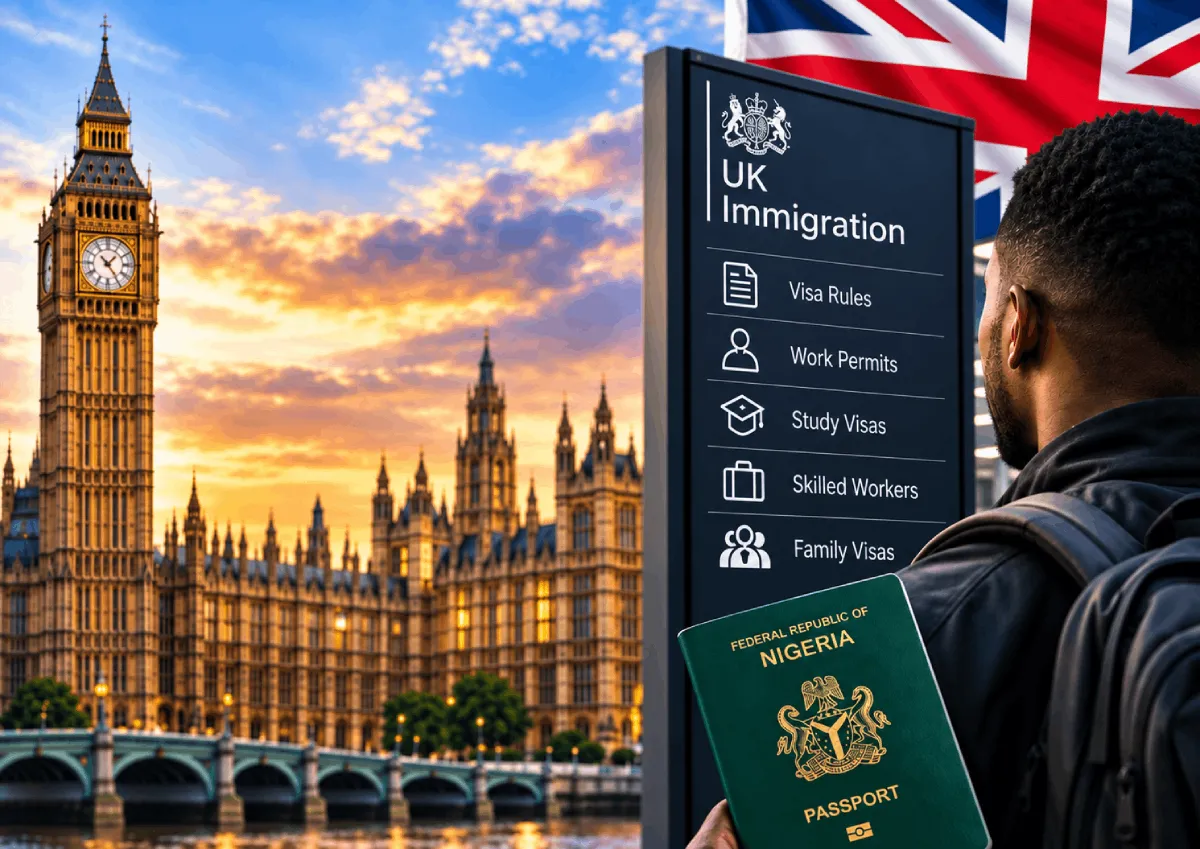
The UK Is Tightening Its Immigration Rules — What Nigerians Need to Know Before 2027
Last modified on September 18, 2026 at 10:29 am

France Tuition Fees 2026–2027: What Non-EU Students Need to Know
Last modified on September 17, 2026 at 3:27 pm

Brazil Introduces Electronic Temporary Visas: Who Can Apply?
Last modified on September 16, 2026 at 4:46 pm
US Green Card Update: Public Charge Changes and September Visa Limits
Last modified on September 16, 2026 at 4:20 pm